Thursday, March 17, 2016

The NixOS project and deploying systems declaratively


Last weekend I was in Wrocław, Poland to attend wroc_love.rb, a conference tailored towards (but not restricted to) applications Ruby related. The reason for me to go to there is because I was invited to give a talk about NixOS.

As I have never visited neither Poland nor a Ruby-related conference before, I did not really know what to expect, but it turned out to be a nice experience. The city, venue and people were all quite interesting, and I liked it very much.

In my talk I basically had two objectives: providing a brief introduction to NixOS and diving into one of its underlying visions: declarative deployment. From my perspective, the former aspect is not particularly new as I have given talks about the NixOS project many times (for example, I also crafted three explanation recipes).

Something that I have not done before is diving into the latter aspect. In this blog post, I'd like to elaborate about it, discuss why it is appealing, and in what extent certain tools reach it.

On being declarative


I have used the word declarative in many of my articles. What is supposed to mean?

I have found a nice presentation online that elaborates on four kinds sentences in linguistics. One of the categories covered in the slides are declarative sentences that (according to the presentation) can be defined as:

A declarative sentence makes a statement. It is punctuated by a period.

As an example, the presentation shows:

The dog in the neighbor's yard is barking.

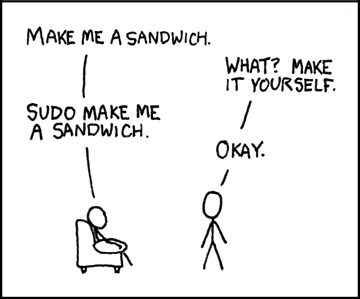
Another class of sentences that the presentation describes are imperative sentences which it defines as:

An imperative sentence is a command or polite request. It ends in a period or exclamation mark.

The following xkcd comic shows an example:

(Besides these two categories of sentences described earlier, the presentation also covers interrogative sentences and exclamatory sentences, but I won't go into detail on that).

On being declarative in programming


In linguistics, the distinction between declarative and imperative sentences is IMO mostly clear -- declarative sentences state facts and imperative sentences are commands or requests.

A similar distinction exists in programming as well. For example, on Wikipedia I found the following definition for declarative programming (the Wikipedia article cites the article: "Practical Advantages of Declarative Programming" written by J.W. Lloyd, which I unfortunately could not find anywhere online):

In computer science, declarative programming is a programming paradigm -- a style of building the structure and elements of computer programs -- that expresses the logic of a computation without describing its control flow.

Imperative programming is sometimes seen as the opposite of declarative programming, but not everybody agrees. I found an interesting discussion blog post written by William Cook that elaborates on their differences.

His understanding of the declarative and imperative definitions are:

Declarative: describing "what" is to be computed rather than "how" to compute the result/behavior

Imperative: a description of a computation that involves implicit effects, usually mutable state and input/output.

Moreover, he says the following:

I agree with those who say that "declarative" is a spectrum. For example, some people say that Haskell is a declarative language, but I my view Haskell programs are very much about *how* to compute a result.

I also agree with William Cook's opinion that declarative is a spectrum -- contrary to linguistics, it is hard to draw a hard line between what and how in programming. Some programming languages that are considered imperative, e.g. C, modify mutable state such as variables:

int a = 5;
a += 3;

But if we would modify the code to work without mutable state, it still remains more a "how" description than a "what" description IMO:

int sum(int a, int b)
{
    return a + b;
}

int result = sum(5, 3);

Two prominent languages that are more about what than how are HTML and CSS. Both technologies empower the web. For example, in HTML I can express the structure of a page:

<!DOCTYPE html>

<html>
    <head>
        <title>Test</title>
        <link rel="stylesheet" href="style.css" type="text/css">
    </head>
    <body>
        <div id="outer">
            <div id="inner">
                <p>HTML and CSS are declarative and so cool!</p>
            </div>
        </div>
    </body>
</html>

In the above code fragment, I define two nested divisions in which a paragraph of text is displayed.

In CSS. I can specify what the style is of these page elements:

#outer {
    margin-left: auto;
    margin-right: auto;
    width: 20%;
    border-style: solid;
}

#inner {
    width: 500px;
}

In the above example, we state that the outer div should be centered, have a width of 20% of the page, and a solid border should be drawn around it. The inner div has a width of 500 pixels.

This approach can be considered declarative, because you do not have to specify how to render the page and the style of the elements (e.g. the text, the border). Instead, this is what the browser's layout engine figures out. Besides being responsible for rendering, it has a number of additional benefits as well, such as:

  • Because it does not matter (much) how a page is rendered, we can fully utilize a system's resources (e.g. a GPU) to render a page in a faster and more fancy way, and optionally degrade a page's appearance if a system's resources are limited.
  • We can also interpret the page in many ways. For example, we can pass the text in paragraphs to a text to speech engine, for people that are visually impaired.

Despite listing some potential advantages, HTML and CSS are not perfect at all. If you would actually check how the example gets rendered in your browser, then you will observe one of CSS's many odd traits, but I am not going to reveal what it is. :-)

Moreover, despite being more declarative (than code written in an imperative programming language such as C) even HTML and CSS can sometimes be considered a "how" specification. For example, you may want to render a photo gallery on your web page. There is nothing in HTML and CSS that allows you to concisely express that. Instead, you need to decompose it into "lower level" page elements, such as paragraphs, hyperlinks, forms and images.

So IMO, being declarative depends on what your goal is -- in some contexts you can exactly express what you want, but in others you can only express things that are in service of something else.

On being declarative in deployment


In addition to development, you eventually have to deploy a system (typically to a production environment) to make it available to end users. To deploy a system you must carry out a number of activities, such as:

  • Building (if a compiled language is used, such as Java).
  • Packaging (e.g. into a JAR file).
  • Distributing (transferring artifacts to the production machines).
  • Activating (e.g. a Java web application in a Servlet container).
  • In case of an upgrade: deactivating obsolete components.

Deployment is often much more complicated than most people expect. Some things that make it complicated are:

  • Many kinds of steps need to be executed, in particular when the technology used is diverse. Without any automation, it becomes extra complicated and time consuming.
  • Deployment in production must be typically done on a large scale. In development, a web application/web service typically serves one user only (the developer), while in production it may need to serve thousands or millions of users. In order to serve many users, you need to manage a cluster of machines having complex constraints in terms of system resources and connectivity.
  • There are non-functional requirements that must be met. For example, while upgrading you want to minimize a system's downtime as much possible. You probably also want to roll back to a previous version if an upgrade went wrong. Accomplishing these properties is often much more complicated than expected (sometimes even impossible!).

As with linguistics and programming, I see a similar distinction in deployment as well -- carrying out the above listed activities are simply the means to accomplish deployment.

What I want (if I need to deploy) is that my system on my development machine becomes available in production, while meeting certain quality attributes of the system that is being deployed (e.g. it could serve thousands of users) and quality attributes of the deployment process itself (e.g. that I can easily roll back in case of an error).

Mainstream solutions: convergent deployment


There are a variety of configuration management tools claiming to support declarative deployment. The most well-known category of tools implement convergent deployment, such as: CFEngine, Puppet, Chef, Ansible.

For example, Chef is driven by declarative deployment specifications (implemented in a Ruby DSL) that may look as follows (I took this example from a Chef tutorial):

...

wordpress_latest = Chef::Config[:file_cache_path] + "/wordpress-latest.tar.gz"

remote_file wordpress_latest do
  source "http://wordpress.org/latest.tar.gz"
  mode "0644"
end

directory node["phpapp"]["path"] do
  owner "root"
  group "root"
  mode "0755"
  action :create
  recursive true
end

execute "untar-wordpress" do
  cwd node['phpapp']['path']
  command "tar --strip-components 1 -xzf " + wordpress_latest
  creates node['phpapp']['path'] + "/wp-settings.php"
end

The objective of the example shown above is deploying a Wordpress web application. What the specification defines is a tarball that must be fetched from the Wordpress web site, a directory that must be created in which a web application is hosted and a tarball that needs to be extracted into that directory.

The specification can be considered declarative, because you do not have to describe the exact steps that need to be executed. Instead, the specification captures the intended outcome of a set of changes and the deployment system converges to the outcome. For example, for the directory that needs to be created, it first checks if it already exists. If so, it will not be created again. It also checks whether it can be created, before attempting to do it.

Converging, instead of directly executing steps, provides additional safety mechanisms and makes deployment processes more efficient as duplicate work is avoided as much as possible.

There are also a number of drawbacks -- it is not guaranteed (in case of an upgrade) that the system can converge to a new set of outcomes. Moreover, while upgrading a system we may observe downtime (e.g. when a new version of the Wordpress is being unpacked). Also, doing a roll back to a previous configuration cannot be done instantly.

Finally, convergent deployment specifications do not guarantee reproducible deployment. For example, the above code does not capture the configuration process of a web server and a PHP extension module, which are required dependencies to run Wordpress. If we would apply the changes to a machine where these components are missing, the changes may still apply but yield a non working configuration.

The NixOS approach


NixOS also supports declarative deployment, but in a different way. The following code fragment is an example of a NixOS configuration:

{pkgs, ...}:

{
  boot.loader.grub.device = "/dev/sda";

  fileSystems = [ { mountPoint = "/"; device = "/dev/sda2"; } ];
  swapDevices = [ { device = "/dev/sda1"; } ];
  
  services = {
    openssh.enable = true;
    
    xserver = {
      enable = true;
      desktopManager.kde4.enable = true;
    };
  };
  
  environment.systemPackages = [ pkgs.mc pkgs.firefox ];
}

In a NixOS configuration you describe what components constitute a system, rather than the outcome of changes:

  • The GRUB bootloader should be installed on the MBR of partition: /dev/sda.
  • The /dev/sda2 partition should be mounted as a root partition, /dev/sda1 should be mounted as a swap partition.
  • We want Mozilla Firefox and Midnight Commander as end user packages.
  • We want to use the KDE 4.x desktop.
  • We want to run OpenSSH as a system service.

The entire machine configuration can be deployed by running single command-line instruction:

$ nixos-rebuild switch

NixOS executes all required deployment steps to deploy the machine configuration -- it downloads or builds all required packages from source code (including all its dependencies), it generates the required configuration files and finally (if all the previous steps have succeeded) it activates the new configuration including the new system services (and deactivating the system services that have become obsolete).

Besides executing the required deployment activities, NixOS has a number of important quality attributes as well:

  • Reliability. Nix (the underlying package manager) ensures that all dependencies are present. It stores new versions of packages next to old versions, without overwriting them. As a result, you can always switch back to older versions if needed.
  • Reproducibility. Undeclared dependencies do not influence builds -- if a build works on one machine, then it works on others as well.
  • Efficiency. Nix only deploys packages and configuration files that are needed.

NixOS is a Linux distribution, but the NixOS project provides other tools bringing the same (or similar) deployment properties to other areas. Nix works on package level (and works on other systems besides NixOS, such as conventional Linux distributions and Mac OS X), NixOps deploys networks of NixOS machines and Disnix deploys (micro)services in networks of machines.

The Nix way of deploying is typically my preferred approach, but these tools also have their limits -- to benefit from the quality properties they provide, everything must be deployed with Nix (and as a consequence: specified in Nix expressions). You cannot take an existing system (deployed by other means) first and change it later, something that you can actually do with convergent deployment tools, such as Chef.

Moreover, Nix (and its sub projects) only manage the static parts of a system such as packages and configuration files (which are made immutable by Nix by making them read-only), but not any state, such as databases.

For managing state, external solutions must be used. For example, I developed a tool called Dysnomia with similar semantics to Nix but it is not always good solution, especially for big chunks of state.

How declarative are these deployment solutions?


I have heard some people claiming that the convergent deployment models are not declarative at all, and the Nix deployment models are actually declarative because they do not specify imperative changes.

Again, I think it depends on how you look at it -- basically, the Nix tools solve problems in a technical domain from declarative specifications, e.g. Nix deploys packages, NixOS entire machine configurations, NixOps networks of machines etc., but typically you would do these kinds of things to accomplish something else, so in a sense you could still consider these approach a "how" rather than a "what".

I have also developed domain-specific deployment tools on top of the tools part of the Nix project allowing me to express concisely what I want in a specific domain:

WebDSL


WebDSL is a domain-specific language for developing web applications with a rich data model, supporting features such as domain modelling, user interfaces and access control. The WebDSL compiler produces Java web applications.

In order to deploy a WebDSL application in a production environment, all kinds of complicated tasks need to be carried out -- we must install a MySQL server, Apache Tomcat server, deploy the web application to the Tomcat server, tune specific settings, and install a reverse proxy that does caching etc.

You typically do not want to express such things in a deployment model. I have developed a tool called webdsldeploy allowing someone to only express the deployment properties that matter for WebDSL applications on a high level. Underneath, the tool consults NixOps (formerly known as Charon) to compose system configurations hosting the components required to run the WebDSL application.

Conference compass


Conference Compass sells services to conference organizers. The most visible part of their service are apps for conference attendees, providing features such as displaying a conference program, list of speakers and floor maps of the venue.

Each customer basically gets "their own app" -- an app for a specific customers has their preferred colors, artwork, content etc. We use a single code base to produce specialized apps.

To produce such specialized apps, we do not want to specify things such as how to build an app for Android through Nix, an app for iOS through Nix, and how to produce debug and release versions etc. These are basically just technical details.

Instead, we have developed our own custom tool that is driven by a specification that concisely expresses what customizations we want (e.g. artwork) and produces the artefacts we want accordingly.

We use a similar approach for our backends -- each app connects to its own dedicated backend allowing users to configure the content displayed in the app. The configurator can also be used to dynamically update the content that is displayed in the apps. For big customers, we offer an additional service in which we develop programs that automatically import data from their information systems.

For the deployment of these backend instances, we do not want to express things such as machines, database services, and the deployment of NPM and Python packages.

Instead, we use a domain-specific tool that is driven by a model that concisely expresses what configurators we want and which third party integrations they provide. The tool is responsible for instantiating virtual machines in the cloud and deploying the services to it.

Conclusion


In this blog post I have elaborated about being declarative in deployment and discussed in what extent certain tools reach it. As with declarative programming, being declarative in deployment is a spectrum.

References


Some aspects discussed in this blog post are covered in my PhD thesis:
  • I did a more elaborate comparison of infrastructure deployment solutions in Chapter 6. I also cover convergent deployment and used CFEngine as an example.
  • I have covered webdsldeploy in Chapter 11, including some background information about WebDSL and its deployment aspects.
  • The overall objective of my PhD thesis is constructing deployment tools for specific domains. Most of the chapters cover the ingredients to do so, but Chapter 3 explains a reference architecture for deployment tools, having similar (or comparable) properties to tools in the Nix project.

For convenience, I have also embedded the slides of my presentation into this web page:

Monday, February 29, 2016

Managing NPM flat module installations in a Nix build environment

Some time ago, I have reengineered npm2nix and described some of its underlying concepts in a blog post. In the reengineered version, I have ported the implementation from CoffeeScript to JavaScript, refactored/modularized the code, and I have been improving the implementation to more accurately simulate NPM's dependency organization, including many of its odd traits.

I have observed that in the latest Node.js (the 5.x series) NPM's behaviour has changed significantly. To cope with this, I did yet another major reengineering effort. In this blog post, I will describe the path that has lead to the latest implementation.

The first attempt


Getting a few commonly used NPM packages deployed with Nix is not particularly challenging, but to make it work completely right turns out to be quite difficult -- the early npm2nix implementations generated Nix expressions that build every package and all of its dependencies in separate derivations (in other words: each package and dependency translates to a separate Nix store path). To allow a package to find its dependencies, the build script creates a node_modules/ sub folder containing symlinks that refer to the Nix store paths of the packages that it requires.

NPM packages have loose dependency specifiers, e.g. wildcards and version ranges, whereas Nix package dependencies are exact, i.e. they bind to packages that are identified by unique hash codes derived from all build time dependencies. npm2nix makes this translation by "snapshotting" the latest conforming version and turning that into into a Nix package.

For example, one my own software projects (NiJS) has the following package configuration file:

{
  "name" : "nijs",
  "version" : "0.0.23",
  "dependencies" : {
    "optparse" : ">= 1.0.3",
    "slasp": "0.0.4"
  }
  ...
}

The package configuration states that it requires optparse version 1.0.3 or higher, and slasp version 0.0.4. Running npm install results in the following directory structure of dependencies:

nijs/
  ...
  package.json
  node_modules/
    optparse/
      package.json
      ...
    slasp/
      package.json
      ...

A node_modules/ folder gets created in which each sub directory represents an NPM package that is a dependency of NiJS. In the older versions of npm2nix, it gets translated as follows:

/nix/store/ab12pq...-nijs-0.0.24/
  ...
  package.json
  node_modules/
    optparse -> /nix/store/4pq1db...-optparse-1.0.5
    slasp -> /nix/store/8j12qp...-slasp-0.0.4
/nix/store/4pq1db...-optparse-1.0.5/
  ...
  package.json
/nix/store/8j12qp...-slasp-0.0.4/
  ...
  package.json

Each involved package is stored in its own private folder in the Nix store. The NiJS package has a node_modules/ folder containing symlinks to its dependencies. For many packages, this approach works well enough, as it at least provides a conforming version for each dependency that it requires.

Unfortunately, it is possible to run into oddities as well. For example, a package that does not work properly in such a model is ironhorse.

For example, we could declare mongoose and ironhorse dependencies of a project:

{
  "name": "myproject",
  "version": "0.0.1",
  "dependencies": {
    "mongoose": "3.8.5",
    "ironhorse": "0.0.11"
  }
}

Ironhorse has an overlapping dependency with the project's dependencies -- it also depends on mongoose, as shown in the following package configuration:

{
  "name": "ironhorse",
  "version": "0.0.11",
  "license" : "MIT",
  "dependencies" : {
    "underscore": "~1.5.2",
    "mongoose": "*",
    "temp": "*",
    ...
  },
  ...
}

Running 'npm install' on project level yields the following directory structure:

myproject/
  ...
  package.json
  node_modules/
    mongoose/
      ...
    ironhorse/
      ...
      package.json
      node_modules/
        underscore/
        temp/

Note that the mongoose only appears one time in the hierarchy of node_modules/ folders despite that it has been declared as a dependency twice.

In contrast, when using an older version of npm2nix, the following directory structure gets generated:

/nix/store/67ab07...-myproject-0.0.1
  ...
  package.json
  node_modules/
    mongoose -> /nix/store/ec704c...-mongoose-3.8.5
    ironhorse -> /nix/store/3ee85e...-ironhorse-0.0.11
/nix/store/3ee85e...-ironhorse-0.0.11
  ...
  package.json
  node_modules/
    underscore -> /nix/store/10af96...-underscore-1.5.2
    mongoose -> /nix/store/a37f75...-mongoose-4.4.5
    temp -> /nix/store/fae379...-temp-0.8.3
/nix/store/ec704c...-mongoose-3.8.5
  package.json
  ...
/nix/store/a37f75...-mongoose-4.4.5
  package.json
  ...
/nix/store/10af96...-underscore-1.5.2
/nix/store/fae379...-temp-0.8.3

In the above directory structure, we can observe that two different versions of mongoose have been deployed -- version 3.8.5 (as a dependency for the project) and version 4.4.5 (as a dependency for ironhorse). Having two different versions of mongoose deployed typically leads to problems.

The reason why npm2nix produces a different result is because whenever NPM encounters a dependency specification, it recursively searches the parent directories to find a conforming version. If a conforming version has been found that fits within the version range of a package dependency, it will not be included again. This is also the reason why NPM can "handle" cyclic dependencies (despite the fact that they are a bad practice) -- when a dependency has been encountered a second time, it will not be deployed again causing NPM to break the cycle.

npm2nix did not implement this kind behaviour -- it always binds a dependency to the latest conforming version, but as can be observed in the last example, this is not what NPM always does -- it could also bind to a shared dependency that may be older than the latest version in the NPM registry (As a sidenote: I wonder how many NPM users actually know about this detail!).

Second attempt: simulating shared dependency behaviour


One of the main objectives in the reengineered version (as described in my previous blog post), is to more accurately mimic NPM's shared dependency behaviour, as the old behaviour was particularly problematic for packages having cyclic dependencies -- Nix does not allow them and causes the evaluation of the entire Nixpkgs set on the Hydra build server to fail as a result.

The reengineered version worked, but the solution was quite expensive and controversial -- I compose Nix expressions of all packages involved, in which each dependency resolves to the latest corresponding version.

Each time a package includes a dependency, I propagate an attribute set to its build function telling it which dependencies have already been resolved by any of the parents. Resolved dependencies get excluded as a dependency.

To check whether a resolved dependency fits within a version range specifier, I have to consult semver. Because semver is unsupported in the Nix expression language, I use a trick in which I import Nix expressions generated by a build script (that invokes the semver command-line utility) to figure out which dependencies have been resolved already.

Besides consulting semver, I used another hack -- packages that have been resolved by any of the parents must be excluded as a dependency. However, NPM packages in Nix are deployed independently from each other in separate build functions and will fail because NPM expects them to present. To solve this problem, I create shims for the excluded packages, by substituting them by empty packages with the same name and version, and removing them after the package has been built.

Symlinking the dependencies also no longer worked reliably -- the CommonJS module system dereferences the location of the includer first and looks in the parent directories for shared dependencies relative from there. This means in case of a symlink, it incorrectly resolves to a Nix store path that has no meaningful parent directories. The only solution I could think of is copying dependencies instead of symlinking them.

To summarize: the new solution worked more accurately than the original version (and can cope with cyclic dependencies) but it is quite inefficient as well -- making copies of dependencies causes a lot of duplication (that would be a waste of disk space) and building Nix expressions in the instantiation phase makes the process quite slow.

Third attempt: computing the dependency graph ahead of time


Apart from the earlier described inefficiencies, the main reason that I had to do yet another major revision is that Node.js 5.x (that includes npm 3.x) executes so-called "flat-module installations. The idea is that when a package includes a dependency, it will be stored in a node_modules/ folder as high in the directory structure as possible without breaking any dependencies.

This new approach has a number of implications. For example, deploying the Disnix virtual hosts test web application with the old npm 2.x used to yield the following directory structure:

webapp/
  ...
  package.json
  node_modules/
    express/
      ...
      package.json
      node_modules/
        accepts/
        array-flatten/
        content-disposition/
        ...
    ejs/
      ...
      package.json

As can be observed in the structure above, the test webapp depends on two packages: express and ejs. Express has dependencies of its own, such as accepts, array-flatten, content-disposition. Because no parent node_modules/ folder provides them, they are included privately for the express package.

Running 'npm install' with the new npm 3.x yields the following directory structure:

webapp/
  ...
  package.json
  node_modules/
    accepts/
    array-flatten/
    content-disposition/
    express/
      ...
      package.json
    ejs/
      ...
      package.json

Since the libraries that express requires do not conflict with the includer's dependencies, they have been moved one level up to the parent package's node_modules/ folder.

Flattening the directory structure makes deploying a NPM project even more imperative -- previously, the dependencies that were included with a package depend on the state of the includer. Now we must also modify the entire directory hierarchy of dependencies by moving packages up in the directory structure. It also makes the resulting dependency graph less predictable. For example, the order in which dependencies are installed matters -- unless all dependencies are discarded and reinstalled from scratch, it may result in different kinds of dependency graphs.

If this flat module approach has all kinds of oddities, why would NPM uses such an approach, you may wonder? It turns out that the only reason is: better Windows support. On Windows, there is a limit on the length on paths and flattening the directory structure helps to prevent hitting it. Unfortunately, it comes at the price of making deployments more imperative and less predictable.

To simulate this flattening strategy, I had to revise npm2nix again. Because of its previous drawbacks and the fact that we have to perform even more imperative operations, I have decided to implement a new strategy in which I compute the entire dependency graph ahead of time by the generator, instead of hacking it into the evaluation phase of the Nix expressions.

Supporting private and shared dependencies works exactly the same as in the old implementation, but is now performed ahead of time. Additionally, I simulate the flat dependency structure as follows:

  • When a package requires a dependency: I check whether the parent directory has a conflicting dependency. This means: it either has a dependency bundled with the same name and a different version or indirectly binds to another parent that provides a conflicting version.
  • If the dependency conflicts: bundle the dependency in the current package.
  • If the dependency does not conflict: bind the package to the dependency (but do not include it) and consult the parent package one level higher.

Besides computing the dependency graph ahead of time, I also deploy the entire dependency graph in one Nix build function -- because including dependencies is stateful, it no longer makes sense to build them as individual Nix packages, that are supposed to be pure.

I have made the flattening algorithm optional. By default, the new npm2nix generates Nix expressions for Node.js 4.x (using the old npm 2.x) release:

$ npm2nix

By appending the -5 parameter, it generates Nix expressions for usage with Node.js 5.x (using the new npm 3.x with flat module installations):

$ npm2nix -5

I have tested the new approach on many packages including my public projects. The good news is: they all seem to work!

Unfortunately, despite the fact that I could get many packages working, the approach is not perfect and hard to get 100% right. For example, in a private project I have encountered bundled dependencies (dependencies that are statically included with a package). NPM also moves them up, while npm2nix merely generates an expression composing the dependency graph (that reflects flat module installations as much as possible). To fix this issue, we must also run a post processing step that moves dependencies up that are in the wrong places. Currently, this step has not been implemented yet in npm2nix.

Another issue is that we want Nix to obtain all dependencies instead of NPM. To prevent NPM from consulting external resources, we substitute some version specifiers (such as Git repositories) by a wildcard: *. These version specifiers sometimes confuse NPM, despite the fact that the directory structure matches NPM's dependency structure.

To cope with these imperfections, I have also added an option to npm2nix to refrain it from running npm install -- in many cases, packages still work fine despite NPM being confused. Moreover, the npm install step in the Nix builder environment merely serves as a validation step -- the Nix builder script is responsible for actually providing the dependencies.

Discussion


In this blog post, I have described the path that has lead to a second reengineered version of npm2nix. The new version computes dependency graphs ahead of time and can mostly handle npm 3.x's flat module installations. Moreover, compared to the previous version, it does no longer rely on very expensive and ugly hacks.

Despite the fact that I can now more or less handle flat installations, I am still not quite happy. Some things that bug me are:

  • The habit of "reusing" modules that have been bundled with any of the includers, makes it IMO difficult and counter-intuitive to predict which version will actually be used in a certain context. In some cases, packagers might expect that the latest version of a version range will be used, but this is not guaranteed to be the case. This could, for example, reintroduce security and stability issues without end users noticing (or expecting) it.
  • Flat module installations are less deterministic and make it really difficult to predict what a dependency graph looks like -- the dependencies that appear at a certain level in the directory structure depend on the order in which dependencies are installed. Therefore, I do not consider this an improvement over npm 2.x.

Because of these drawbacks, I expect that NPM will reconsider some of its concepts again in the future causing npm2nix to break again.

I would recommend the NPM developers to use the following approach:

  • All involved packages should be stored in a single node_modules/ folder instead of multiple nested hierarchies of node_modules/ folders.
  • When a module requests another module, the module loader should consult the package.json configuration file of the package where the includer module belongs to. It should take the latest conforming version in the central node_modules/ folder. I consider taking the last version of a version range to be less counter-intuitive than taking any conforming version.
  • To be able to store multiple versions of packages in a single node_modules/ folder, a better directory naming convention should be adopted. Currently, NPM only identifies modules by name in a node_modules/ folder, making it impossible to store two versions next to each other in one directory.

    If they would, for example, use both the name and version numbers in the directory names, more things are possible. Adding more properties in the path names makes sharing even better -- for example, a package with a name and version number could originate from various sources, e.g. the NPM registry or a Git repository -- reflecting this in the path makes it possible to store more variants next to each other in a reliable way.

    Naming things to improve shareability is not really rocket science -- Nix uses hash codes (that are derived from all build-time dependencies) to uniquely identify packages and the .NET Global Assembly Cache uses so-called strong names that include various naming attributes, such as cryptographic keys to ensure that no library conflicts. I am convinced that adopting a better naming convention for storing NPM packages would be quite beneficial as well.
  • To cope with cyclic dependencies: I would simply say that it suffices to disallow them. Packages are supposed to be units of reuse, and if two packages mutually depend on each other, then they should be combined into one package.

Availability


The second reengineered npm2nix version can be obtained from my GitHub page. The code resides in the reengineering2 branch.

Thursday, January 28, 2016

Disnix 0.5 release announcement and some reflection

In this blog post, I'd like to announce the next Disnix release. At the same time, I noticed that it has been eight years ago that I started developing it, so this would also be a nice opportunity to do some reflection.

Some background information


The idea was born while I was working on my master's thesis. A few months prior, I got familiar with Nix and NixOS -- I read Eelco Dolstra's PhD thesis, managed to package some software, and wrote a couple of services for NixOS.

Most of my packing work was done to automate the deployment of WebDSL applications, a case study in domain-specific language engineering, that is still an ongoing research project in my former research group. WebDSL's purpose is to be a domain-specific language for developing dynamic web applications with a rich data model.

Many aspects in Nix/NixOS were quite "primitive" compared to today's implementations -- there was no NixOS module system, making it less flexible to create additions. Many packages that I needed were missing and I had to write Nix expressions for them myself, such as Apache Tomcat, MySQL, and Midnight Commander. Also the desktop experience, such as KDE, was quite primitive, as only the base package was supported.

As part of my master's thesis project, I did an internship at the Healthcare Systems Architecture group at Philips Research. They had been developing a platform called SDS2, which purpose was to provide asset tracking and utilization analysis services for medical equipment.

SDS2 qualifies itself as a service-oriented system (a term that people used to talk frequently about in the past, but not anymore :) ). As such, it can be decomposed into a set of distributable components (a.k.a. services) that interact with each other through "standardized protocols" (e.g. SOAP), sometimes through network links.

There are a variety of reasons why SDS2 has a distributed architecture. For example, data that has been gathered from medical devices may have to be physically stored inside a hospital for privacy reasons. The analysis components may require a lot of computing power and would perform better if they run in a data center with a huge amount of system resources.

Being able to distribute services is good for many reasons (e.g. in meeting certain non-functional requirements such as privacy), but it also has a big drawback -- services are software components, and one of their characteristics is that they are units of deployment. Deploying a single service without any (or proper) automation to one machine is already complicated and time consuming, but deploying a network of machines is many times as complex.

The goal of my thesis assignment was to automate SDS2's deployment in distributed environments using the Nix package manager as a basis. Nix provides a number of unique properties compared to many conventional deployment solutions, such as fully automated deployment from declarative specifications, and reliable and reproducible deployment. However, it was also lacking a number of features to provide the same or similar kinds of quality properties to deployment processes of service-oriented systems in networks of machines.

The result of my master's thesis project was the first prototype of Disnix that I never officially released. After my internship, I started my PhD research and resumed working on Disnix (as well as several other aspects). This resulted in a second prototype and two official releases eventually turning Disnix into what it is today.

Prototype 1


This was the prototype resulting from my master's thesis and was primarily designed for deploying SDS2.

The first component that I developed was a web service (using similar kinds of technologies as SDS2, such as Apache Tomcat and Apache Axis2) exposing a set of deployment operations to remote machines (most of them consulting the Nix package manager).

To cope with permissions and security, I decided to make the web service just an interface around a "core service" that was responsible for actually executing the deployment activities. The web service used the D-Bus protocol to communicate with the core.

On top of the web service layer, I implemented a collection of tools each executing a specific deployment activity in a network of machines, such as building, distributing and activating services. There were also a number of tools combining deployment activities, such as the "famous" disnix-env command responsible for executing all the activities required to deploy a system.

The first prototype of disnix-env, in contrast to today's implementation, provided two deployment procedure variants: building on targets and building on the coordinator.

The first variant was basically inspired by the manual workflow I used to carry out to get SDS2 deployed -- I manually installed a couple of NixOS machines, then used SSH to remotely connect to them, there I would do a checkout of Nixpkgs and all the other Nix expressions that I need, then I would deploy all packages from source and finally I modified the system configuration (e.g. Apache Tomcat) to run the web services.

Unfortunately, transferring Nix expressions is not an easy process, as they are rarely self contained and typically rely on other Nix expression files scattered over the file system. While thinking about a solution, I "discovered" that the Nix expression evaluator creates so-called store derivation files (low-level build specifications) for each package build. Store derivations are also stored in the Nix store next to ordinary packages, including their dependencies. I could instead instantiate a Nix expression on the coordinator, transfer the closure of store derivation files to a remote machine, and build them there.

After some discussion with my company supervisor Merijn de Jonge, I learned that compiling on target machines was undesired, in particular in production environments. Then I learned more about Nix's purely functional nature, and "discovered" that builds are referentially transparent -- for example, it should not matter where a build has been performed. As long as the dependencies remain the same, the outcome would be the same as well. With this "new knowledge" in mind, I implemented a second deployment procedure variant that would do the package builds on the coordinator machine, and transfer their closures (dependencies) to the target machines.

As with the current implementation, deployment in Disnix was driven by three kinds of specifications: the services model, infrastructure model and distribution model. However, their notational conventions were a bit different -- the services model already knew about inter-dependencies, but propagating the properties of inter-dependencies to build functions was an ad-hoc process. The distribution model was a list of attribute sets also allowing someone to specify the same mappings multiple times (which resulted in undefined outcomes).

Another primitive aspect was the activation step, such as deploying web applications inside Apache Tomcat. It was basically done by a hardcoded script that only knew about Java web applications and Java command-line tools. Database activation was completely unsupported, and had to be done by hand.

I also did a couple of other interesting things. I studied the "two-phase commit protocol" for upgrading distributed systems atomically and mapped its concepts to Nix operations, to support (almost) atomic upgrades. This idea resulted in a research paper that I have presented at HotSWUp 2008.

Finally, I sketched a simple dynamic deployment extension (and wrote a partial implementation for it) that would calculate a distribution model, but time did not permit me to finish it.

Prototype 2


The first Disnix prototype made me quite happy in the early stages of my PhD research -- I gave many cool demos to various kinds of people, including our industry partner: Philips Healthcare and NWO/Jacquard: the organization that was funding me. However, I soon realized that the first prototype became too limited.

The first annoyance was my reliance on Java. Most of the tools in the Disnix distribution were implemented in Java and depended on the Java Runtime Environment, which is quite a big dependency for a set of command-line utilities. I reengineered most of the Disnix codebase and rewrote it in C. I only kept the core service (which was implemented in C already) and the web service interface, that I separated into an external package called DisnixWebService.

I also got rid of the reliance on a web service to execute remote deployment operations, because it was quite tedious to deploy it. I made the communication aspect pluggable and implemented an SSH plugin that became the default communication protocol (the web service protocol could still be used as an external plugin).

For the activation and deactivation of services, I developed a plugin system (Disnix activation scripts) and a set of modules supporting various kinds of services replacing the hardcoded script. This plugin system allowed me to activate and deactivate many kinds of components, including databases.

Finally, I unified the two deployment procedure variants of disnix-env into one procedure. Building on the targets became simply an optional step that was carried out before building on the coordinator.

Disnix 0.1


After my major reengineering effort, I was looking into publishing something about it. While working on a paper (which first version got badly rejected), I realized that services in a SOA-context are "platform independent" because of their interfaces, but they still have implementations underneath that could depend on many kinds of technologies. Heterogeneity makes deployment extra complicated.

There was still one piece missing to bring service-oriented systems to their full potential -- there was no multiple operating systems support in Disnix. The Nix package manager could also be used on several other operating systems besides Linux, but Disnix was bound to one operating system only (Linux).

I did another major reengineering effort to make the system architecture of the target systems configurable requiring me to change many things internally. I also developed new notational conventions for the Disnix models. Each service expression became a nested function in which the outer function corresponds to the intra-dependencies and the inner function to the inter-dependencies, and look quite similar to expressions for ordinary Nix packages. Moreover, I removed the ambiguity problem in the distribution model by making it an attribute set.

The resulting Disnix version was first described in my SEAA 2010 paper. Shortly after the paper got accepted, I decided to officially release this version as Disnix 0.1. Many external aspects of this version are still visible in the current version.

Disnix 0.2


After releasing the first of Disnix, I realized that there were still a few pieces missing while automating deployment processes of service-oriented systems. One of the limitations of Disnix is that it expects machines to be present already that may have to run a number of preinstalled system services, such as MySQL, Apache Tomcat, and the Disnix service exposing remote deployment operations. These machines had to be deployed by other means first.

Together with Eelco Dolstra I had been working on declarative deployment and testing of networked NixOS configurations, resulting in a tool called nixos-deploy-network that deploys networks of NixOS machines and a NixOS test driver capable of spawning networks of NixOS virtual machines in which system integration tests can be run non-interactively. These contributions were documented in a tech report and the ISSRE 2010 paper.

I made Disnix more modular so that extensions could be built on top of it. The most prominent extension was DisnixOS that integrates NixOS deployment and the NixOS test driver's features with Disnix service deployment so that a service oriented system's deployment process could be fully automated.

Another extension was Dynamic Disnix, a continuation of the dynamic deployment extension that I never finished during my internship. Dynamic Disnix extends the basic toolset with an infrastructure discovery tool and a distribution generator using deployment planning algorithms from the academic literature to map services to machines. The extended architecture is described in the SEAMS 2011 paper.

The revised Disnix architecture has been documented in both the WASDeTT 2010 and SCP 2014 papers and was released as Disnix 0.2.

Disnix 0.3


After the 0.2 release I got really busy, which was partly caused by the fact that I had to write my PhD thesis and yet another research paper for an unfinished chapter.

The last Disnix-related research contribution was a tool called Dysnomia, which I had based on the Disnix activation scripts package. I augmented the plugins with experimental state deployment operations and changed the package into a new tool, that in (theory) could be combined with other tools as well, or used independently.

Unfortunately, I had to quickly rush out a paper for HotSWUp 2012 and the code was in a barely usable state. Moreover, the state management facilities had some huge drawbacks, so I was not that eager to get them integrated into the mainstream version.

Then I had to fully dedicate myself to completing my PhD thesis and for more than six months, I hardly wrote any code.

After finishing my first draft of my PhD thesis and waiting for feedback from my committee, I left academia and switched jobs. Because I had no use practical use cases for Disnix, and other duties in my new job, its development was done mostly in my spare time at a very low pace -- some things that I accomplished in that period is creating a 'slim' version of Dysnomia that supported all the activities in the HotSWUp paper without any snapshotting facilities.

Meanwhile, nixops-deploy-network got replaced by a new tool named Charon, that later became NixOps. In addition to deployment, NixOps could also instantiate virtual machines in IaaS environments, such as Amazon EC2. I modified DisnixOS to also integrate with NixOps to use its capabilities.

Three and a half years after the previous release (late 2014), my new employer wanted to deploy their new microservices-based system to a production environment, which made me quite motivated to work on Disnix again. I did some huge refactorings and optimized a few aspects to make it work for larger systems. Some interesting optimizations were concurrent data transfers and concurrent service activations.

I also implemented multi-connection protocol support. For example, you could use SSH to connect to one machine and SOAP to another.

After implementing the optimizations, I realized that I had reached a stable point and decided that it was a good time to announce the next release, after a few years of only little development activity.

Disnix 0.4


Despite being happy with the recent Disnix 0.3 release and using it to deploy many services to production environments, I quickly ran into another problem -- the services that I had to manage store data in their own dedicated databases. Sometimes I had to move services from one machine to another. Disnix (like the other Nix tools) does not manage state, requiring me to manually migrate data, which was quite painful.

I decided to dig up the state deployment facilities from the HotSWUp 2012 paper to cope with this problem. Despite having a number of limitations, the databases that I had to manage were relatively small (tens of megabytes), so the solution was still a good fit.

I integrated the state management facilities described in the paper from the prototype into the "production" version of Dysnomia, and modified Disnix to use them. I left out the incremental snapshot facilities described in the paper, because there was no practical use for them. When the work was done, I announced the next release.

Disnix 0.5


With Disnix 0.4, all my configuration management work was automated. However, I spotted a couple of inefficiencies, such as many unnecessary redeployments while upgrading. I solved this issue by making the target-specific services concept a first class citizen in Disnix. Moreover, I regularly had to deal with RAM issues and added on-demand activation support (by using the operating system's service manager, such as systemd).

There were also some user-unfriendly aspects that I improved -- better and more concise logging, more helpful error messages, --rollback, --switch-generation options for disnix-env, and some commands that work on the deployment manifest were extended to take the last deployed manifest into account when no parameters have been provided (e.g. disnix-visualize).

Conclusion


This long blog post describes how the current Disnix version (0.5) came about after nearly eight years of development. I'd like to announce its immediate availability! Consult the Disnix homepage for more information.

Friday, January 22, 2016

Integrating callback and promise based function invocation patterns (Asynchronous programming with JavaScript part 4)

It has been quiet for a while on my blog in the programming language domain. Over two years ago, I started writing a series of blog posts about asynchronous programming with JavaScript.

In the first blog post, I explained some general asynchronous programming issues, code structuring issues and briefly demonstrated how the async library can be used to structure code more properly. Later, I have written a blog post about promises, another abstraction mechanism dealing with asynchronous programming complexities. Finally, I have developed my own abstraction functions by investigating how JavaScript's structured programming language constructs (that are synchronous) translate to the asynchronous programming world.

In these blog posts, I have used two kinds of function invocation styles -- something that I call the Node.js-function invocation style, and the promises invocation style. As the name implies, the former is used by the Node.js standard library, as well as many Node.js-based APIs. The latter is getting more common in the browser world. As a matter of fact, many modern browsers, provide a Promise prototype as part of their DOM API allowing others to construct their own Promise-based APIs with it.

In this blog post, I will compare both function invocation styles and describe some of their differences. Additionally, there are situations in which I have to mix APIs using both styles and I have observed that it is quite annoying to combine them. I will show how to alleviate this pain a bit by developing my own generically applicable adapter functions.

Two example invocations


The most frequently used invocation style in my blog posts is something that I call the Node.js-function invocation style. An example code fragment that uses such an invocation is the following:

fs.readFile("hello.txt", function(err, data) {
    if(err) {
        console.log("Error while opening file: "+err);
    } else {
        console.log("File contents is: "+data);
    }
});

As you may see in the code fragment above, when we invoke the readFile() function, it returns immediately (to be precise: it returns, but it returns no value). We use a callback function (that is typically the last function parameter) to retrieve the results of the invocation (or the error if something went wrong) at a later point in time.

By convention, the first parameter of the callback is an error parameter that is not null if some error occurs. The remaining parameters are optional and can be used to retrieve the corresponding results.

When using promises (more specifically: promises that conform to the Promises/A and Promises/A+ specifications), we use a different invocation pattern that may look as follows:

Task.findAll().then(function(tasks) {
    for(var i = 0; i < tasks.length; i++) {
        var task = tasks[i];
        console.log(task.title + ": "+ task.description);
    }
}, function(err) {
    console.log("An error occured: "+err);
});

As with the previous example, the findAll() function invocation shown above also returns immediately. However, it also does something different compared to the Node.js-style function invocation -- it returns an object called a promise whereas the invocation in the previous example never returns anything.

By convention, the resulting promise object provides a method called then() in which (according the Promises/A and A+ standards) the first parameter is a callback that gets invoked when the function invocation succeeds and the second callback gets invoked when the function invocation fails. The parameters of the callback functions represent result objects or error objects.

Comparing the invocation styles


At first sight, you may probably notice that despite having different styles, both function invocations return immediately and need an "artificial facility" to retrieve the corresponding results (or errors) at a later point in time, as opposed to directly returning a result in a function.

The major difference is that in the promises invocation style, you will always get a promise as a result of an invocation. A promise provides a reference to something which corresponding result will be delivered in the future. For example, when running:

var tasks = Task.findAll();

I will obtain a promise that, at some point in the future, provides me an array of tasks. I can use this reference to do other things by passing the promise around (for example) as a function argument to other functions.

For example, I may want to construct a UI displaying the list of tasks. I can already construct pieces of it without waiting for the full list of tasks to be retrieved:

displayTasks(tasks);

The above function could, for example, already start rendering a header, some table cells and buttons without the results being available yet. The display function invokes the then() function when it really needs the data.

By contrast, in the Node.js-callback style, I have no reference to the pending invocation at all. This means that I always have to wait for its completion before I can render anything UI related. Because we are forced to wait for its completion, it will probably make the application quite unresponsive, in particular when we have to retrieve many task records.

So in general, in addition to better structured code, promises support composability whereas Node.js-style callbacks do not. Because of this reason, I consider promises to be more powerful.

However, there is also something that I consider a disadvantage. In my first blog post, I have shown the following Node.js-function invocation style pyramid code example as a result of nesting callbacks:

var fs = require('fs');
var path = require('path');

fs.mkdir("out", 0755, function(err) {
    if(err) throw err;
    
    fs.mkdir(path.join("out, "test"), 0755, function(err) {
        if (err) throw err;        
        var filename = path.join("out", "test", "hello.txt");

        fs.writeFile(filename, "Hello world!", function(err) {
            if(err) throw err;
                    
            fs.readFile(filename, function(err, data) {
                if(err) throw err;
                
                if(data == "Hello world!")
                    process.stderr.write("File is correct!\n");
                else
                    process.stderr.write("File is incorrect!\n");
            });
        });
    });
});

I have also shown in the same blog post, that I can use the async.waterfall() abstraction to flatten its structure:

var fs = require('fs');
var path = require('path');

filename = path.join("out", "test", "hello.txt");

async.waterfall([
    function(callback) {
        fs.mkdir("out", 0755, callback);
    },

    function(callback) {
        fs.mkdir(path.join("out, "test"), 0755, callback);
    },

    function(callback) {
        fs.writeFile(filename, "Hello world!", callback);
    },

    function(callback) {
        fs.readFile(filename, callback);
    },

    function(data, callback) {
        if(data == "Hello world!")
            process.stderr.write("File is correct!\n");
        else
            process.stderr.write("File is incorrect!\n");
    }

], function(err, result) {
    if(err) throw err;
});
As you may probably notice, the code fragment above is much more readable and better maintainable.

In my second blog post, I implemented a promises-based variant of the same example:

var fs = require('fs');
var path = require('path');
var Promise = require('rsvp').Promise;

/* Promise object definitions */

var mkdir = function(dirname) {
    return new Promise(function(resolve, reject) {
        fs.mkdir(dirname, 0755, function(err) {
            if(err) reject(err);
            else resolve();
        });
    });
};

var writeHelloTxt = function(filename) {
    return new Promise(function(resolve, reject) {
        fs.writeFile(filename, "Hello world!", function(err) {
            if(err) reject(err);
            else resolve();
        });
    });
};

var readHelloTxt = function(filename) {
    return new Promise(function(resolve, reject) {
        fs.readFile(filename, function(err, data) {
            if(err) reject(err);
            else resolve(data);
        });
    });
};

/* Promise execution chain */

var filename = path.join("out", "test", "hello.txt");

mkdir(path.join("out"))
.then(function() {
    return mkdir(path.join("out", "test"));
})
.then(function() {
    return writeHelloTxt(filename);
})
.then(function() {
    return readHelloTxt(filename);
})
.then(function(data) {
    if(data == "Hello world!")
        process.stderr.write("File is correct!\n");
    else
        process.stderr.write("File is incorrect!\n");
}, function(err) {
    console.log("An error occured: "+err);
});

As you may notice, because the then() function invocations can be chained, we also have a flat structure making the code better maintainable. However, the code fragment is also considerably longer than the async library variant and the unstructured variant -- for each asynchronous function invocation, we must construct a promise object, adding quite a bit of overhead to the code.

From my perspective, if you need to do many ad-hoc steps (and not having to compose complex things), callbacks are probably more convenient. For reusable operations, promises are typically a nicer solution.

Mixing function invocations from both styles


It may happen that function invocations from both styles need to be mixed. Typically mixing is imposed by third-party APIs -- for example, when developing a Node.js web application we may want to use express.js (callback based) for implementing a web application interface in combination with sequelize (promises based) for accessing a relational database.

Of course, you could write a function constructing promises that internally only use Node.js-style invocations or the opposite. But if you have to regularly intermix calls, you may end up writing a lot of boilerplate code. For example, if I would use the async.waterfall() abstraction in combination with promise-style function invocations, I may end up writing:

async.waterfall([
    function(callback) {
        Task.sync().then(function() {
            callback();
        }, function(err) {
            callback(err);
        });
    },
    
    function(callback) {
        Task.create({
            title: "Get some coffee",
            description: "Get some coffee ASAP"
        }).then(function() {
            callback();
        }, function(err) {
            callback(err);
        });
    },
    
    function(callback) {
        Task.create({
            title: "Drink coffee",
            description: "Because I need caffeine"
        }).then(function() {
            callback();
        }, function(err) {
            callback(err);
        });
    },
    
    function(callback) {
        Task.findAll().then(function(tasks) {
            callback(null, tasks);
        }, function(err) {
            callback(err);
        });
    },
    
    function(tasks, callback) {
        for(var i = 0; i < tasks.length; i++) {
            var task = tasks[i];
            console.log(task.title + ": "+ task.description);
        }
    }
], function(err) {
    if(err) {
        console.log("An error occurred: "+err);
        process.exit(1);
    } else {
        process.exit(0);
    }
});

For each Promise-based function invocation, I need to invoke the then() function and in the corresponding callbacks, I must invoke the callback of each function block to propagate the results or the error. This makes the amount of code I have to write unnecessary long, tedious to write and a pain to maintain.

Fortunately, I can create a function that abstracts over this pattern:

function chainCallback(promise, callback) {
    promise.then(function() {
        var args = Array.prototype.slice.call(arguments, 0);
        
        args.unshift(null);
        callback.apply(null, args);
    }, function() {
        var args = Array.prototype.slice.call(arguments, 0);
        
        if(args.length == 0) {
            callback("Promise error");
        } else if(args.length == 1) {
            callback(args[0]);
        } else {
            callback(args);
        }
    });
}

The above code fragment does the following:

  • We define a function takes a promise and a Node.js-style callback function as parameters and invokes the then() method of the promise.
  • When the promise has been fulfilled, it sets the error parameter of the callback to null (to indicate that there is no error) and propagates all resulting objects as remaining parameters to the callback.
  • When the promise has been rejected, we propagate the resulting error object. Because the Node.js-style-callback requires a single defined object, we compose one ourselves if no error object was returned, and we return an array as an error object, if multiple error objects were returned.

Using this abstraction function, we can rewrite the earlier pattern as follows:

async.waterfall([
    function(callback) {
        prom2cb.chainCallback(Task.sync(), callback);
    },
    
    function(callback) {
        prom2cb.chainCallback(Task.create({
            title: "Get some coffee",
            description: "Get some coffee ASAP"
        }), callback);
    },
    
    function(callback) {
        prom2cb.chainCallback(Task.create({
            title: "Drink coffee",
            description: "Because I need caffeine"
        }), callback);
    },
    
    function(callback) {
        prom2cb.chainCallback(Task.findAll(), callback);
    },
    
    function(tasks, callback) {
        for(var i = 0; i < tasks.length; i++) {
            var task = tasks[i];
            console.log(task.title + ": "+ task.description);
        }
    }
], function(err) {
    if(err) {
        console.log("An error occurred: "+err);
        process.exit(1);
    } else {
        process.exit(0);
    }
});

As may be observed, this code fragment is more concise and significantly shorter.

The opposite mixing pattern also leads to issues. For example, we can first retrieve the list of tasks from the database (through a promise-style invocation) and then write it as a JSON file to disk (through a Node.js-style invocation):

Task.findAll().then(function(tasks) {
    fs.writeFile("tasks.txt", JSON.stringify(tasks), function(err) {
        if(err) {
            console.log("error: "+err);
        } else {
            console.log("everything is OK");
        }
    });
}, function(err) {
    console.log("error: "+err);
});

The biggest annoyance is that we are forced to do the successive step (writing the file) inside the callback function, causing us to write pyramid code that is harder to read and tedious to maintain. This is caused by the fact that we can only "chain" a promise to another promise.

Fortunately, we can create a function abstraction that wraps an adapter around any Node.js-style function taking the same parameters (without the callback) that returns a promise:

function promisify(Promise, fun) {
    return function() {
       var args = Array.prototype.slice.call(arguments, 0);
           
       return new Promise(function(resolve, reject) {
            function callback() {
                var args = Array.prototype.slice.call(arguments, 0);
                var err = args[0];
                args.shift();
                    
                if(err) {
                    reject(err);
                } else {
                    resolve(args);
                }
            }
           
            args.push(callback);
                
            fun.apply(null, args);
        });
    };
}

In the above code fragment, we do the following:

  • We define a function that takes two parameters: a Promise prototype that can be used to construct promises and a function representing any Node.js-style function (which the last parameter is a Node.js-style callback).
  • In the function, we construct (and return) a wrapper function that returns a promise.
  • We construct an adapter callback function, that invokes the Promise toolkit's reject() function in case of an error (with the corresponding error object provided by the callback), and resolve() in case of success. In case of success, it simply propagates any result object provided by the Node.js-style callback.
  • Finally, we invoke the Node.js-function with the given function parameters and our adapter callback.

With this function abstraction we can rewrite the earlier example as follows:

Task.findAll().then(function(tasks) {
    return prom2cb.promisify(Promise, fs.writeFile)("tasks.txt", JSON.stringify(tasks));
})
.then(function() {
    console.log("everything is OK");
}, function(err) {
    console.log("error: "+err);
});

as may be observed, we can convert the writeFile() Node.js-style function invocation into an invocation returning a promise, and nicely structure the find and write file invocations by chaining then() invocations.

Conclusions


In this blog post, I have explored two kinds of asynchronous function invocation patterns: Node.js-style and promise-style. You may probably wonder which one I like the most?

I actually hate them both, but I consider promises to be the more powerful of the two because of their composability. However, this comes at a price of doing some extra work to construct them. The most ideal solution to me is still a facility that is part of the language, instead of "forgetting" about existing language constructs and replacing them by custom-made abstractions.

I have also explained that we may have to combine both patterns, which is often quite tedious. Fortunately, we can create function abstractions that convert one into another to ease the pain.

Related work


I am not the first one comparing the function invocation patterns described in this blog post. Parts of this blog post are inspired by a blog post titled: "Callbacks are imperative, promises are functional: Node’s biggest missed opportunity". In this blog post, a comparison between the two invocation styles is done from a programming language paradigm perspective, and is IMO quite interesting to read.

I am also not the first to implement conversion functions between these two styles. For example, promises constructed with the bluebird library implement a method called .asCallback() allowing a user to chain a Node.js-style callback to a promise. Similarly, it provides a function: Promise.promisify() to wrap a Node.js-style function into a function returning a promise.

However, the downside of bluebird is that these facilities can only be used if bluebird is used as a toolkit in an API. Some APIs use different toolkits or construct promises themselves. As explained earlier, Promises/A and Promises/A+ are just interface specifications and only the purpose of then() is defined, whereas the other facilities are extensions.

My function abstractions only make a few assumptions and should work with many implementations. Basically it only requires a proper .then() method (which should be obvious) and a new Promise(function(resolve, reject) { ... }) constructor.

Besides the two function invocation styles covered in this blog post, there are others as well. For example, Zef's blog post titled: "Callback-Free Harmonious Node.js" covers a mechanism called 'Thunks'. In this pattern, an asynchronous function returns a function, which can be invoked to retrieve the corresponding error or result at a later point in time.

References


The two conversion abstractions described in this blog post are part of a package called prom2cb. It can be obtained from my GitHub page and the NPM registry.

Wednesday, December 30, 2015

Fifth yearly blog reflection

Today, it's my blog's fifth anniversary. As usual, this is a nice opportunity to reflect over last year's writings.

Disnix


Something that I cannot leave unmentioned is Disnix, a toolset that I have developed as part of my master's and PhD research. For quite some time, its development was progressing at a very low pace, mainly because I had other obligations -- I had to finish my PhD thesis, and after I left academia, I was working on other kinds of aspects.

Fortunately, things have changed considerably. Since October last year I have been actively using Disnix to maintain the deployment of a production system that can be decomposed into independently deployable services. As a result, the development of Disnix also became much more progressive, which resulted in a large number of Disnix related blog posts and some major improvements.

In the first blog post, I compared Disnix with another tool from the Nix project: NixOps, described their differences and demonstrated that they can be combined to fully automate all deployment aspects of a service-oriented system. Shortly after publishing this blog post, I announced the next Disnix release: Disnix 0.3, 4 years after its previous release.

A few months later, I announced yet another Disnix release: Disnix 0.4 in which I have integrated the majority of state deployment facilities from the prototype described in the HotSWUp 2012 paper.

The remainder of blog posts provide solutions for additional problems and describe some optimizations. I have formulated a port assignment problem which may manifest itself while deploying microservices and developed a tool that can be used to provide a solution. I also modified Disnix to deploy target-specific services (in addition to target-agnostic services), which in some scenarios, make deployments more efficient.

Another optimization that I have developed is on demand activation and self termination of services. This is particularly useful for poorly developed services, that for example, leak memory.

Finally, I have attended NixCon2015 where I gave a talk about Disnix (including two live demos) and shown how it can be used to deploy (micro)services. An interesting aspect of the presentation is the first live demo in which I deploy a simple example system into a network of heterogeneous machines (machines running multiple operating systems, having multiple CPU architectures, reachable by multiple connection protocols).

The Nix project


In addition to Disnix, I have also written about some general Nix aspects. In February, I have visited FOSDEM. In this year's edition, we had a NixOS stand to promote the project (including its sub projects). From my own personal experience, I know that advertising Nix is quite challenging. For this event, I crafted a sales pitch explanation recipe, that worked quite well for me in most cases.

A blog post that I am particularly proud of is my evaluation and comparison of Snappy Ubuntu with Nix/NixOS, in which I describe the deployment properties of Snappy and compare how they conceptually relate to Nix/NixOS. It attracted a huge amount of visitors breaking my old monthly visitors record from three years ago!

I also wrote a tutorial blog post demonstrating how we can deploy prebuilt binaries with the Nix package manager. In some cases, packaging prebuilt software can be quite challenging, and the purpose of this blog post to show a number techniques that can be used to accomplish this.

Methodology


Besides deployment, I have also written two methodology related blog posts. In the first blog post, I have described my experiences with Agile software development and Scrum. Something that has been bothering me for quite a while is these people claiming that "implementing" such a methodology considerably improves development and quality of software.

In my opinion this is ridiculous! These methodologies provide some structure, but the "secret" lies in its undefined parts -- to be agile you should accept that nothing will completely go as planned, you should remain focussed, take small steps (not huge leaps), and most importantly: continuously adapt and improve. But no methodology provides a universally applicable recipe that makes you successful in doing it.

However, despite being critical, I think that implementing a methodology is not bad per se. In another blog post, I have described how I implemented a basic software configuration management process in a small organization.

Development


I have also reflected over my experiences while developing command-line utilities and wrote a blog post with some considerations I take into account.

Side projects and research


In my previous reflections, there was always a section dedicated to research and side projects. Unfortunately, this year there is not much to report about -- I made a number of small changes and additions to my side projects, but I did not made any significant advancements.

Probably the fact that Disnix became a main and side project contributes to that. Moreover, I also have other stuff to do that has nothing to do with software development or research. I hope that I can find more time next year to report about my other side projects, but I guess this is basically just a luxury problem. :-)

Blog posts


As with my previous annual blog reflections, I will also publish the top 10 of my most frequently read blog posts:

  1. On Nix and GNU Guix. As with the previous three blog reflections, this blog post remains on top. However, its popularity finally seems to be challenged by the number two!
  2. An evaluation and comparison of Snappy Ubuntu. This is the only blog post I have written this year that ended up in the overall top 10. It attracted a record number of visitors in one month and now rivals the number one in popularity.
  3. An alternative explanation of the Nix package manager. This was last year's number two and dropped to the third place, because of the Snappy Ubuntu blog post.
  4. Setting up a multi-user Nix installation on non-NixOS systems. This blog post was also in last year's top 10 but it seems to have become even more popular. I think this is probably caused by the fact that it is still hard to set up a multi-user installation.
  5. Managing private Nix packages outside the Nixpkgs tree. I wrote this blog for newcomers and observed that people keep frequently consulting it. As a consequence, it has entered the overall top 10.
  6. Asynchronous programming with JavaScript. This blog post was also in last year's top 10 and became slightly more popular. As a result, it moved to the 6th position.
  7. Yet another blog post about Object Oriented Programming and JavaScript. Another JavaScript related blog post that was in last year's top 10. It became slightly more popular and moved to the 7th place.
  8. Composing FHS-compatible chroot environments with Nix (or deploying Steam in NixOS). This blog post was the third most popular last year, but now seems to be not that interesting anymore.
  9. Setting up a Hydra build cluster for continuous integration and testing (part 1). Remains a popular blog post, but also considerably dropped in popularity compared to last year.
  10. Using Nix while doing development. A very popular blog post last year, but considerably dropped in popularity.

Conclusion


I am still not out of ideas yet, so stay tuned! The remaining thing I want to say is:

HAPPY NEW YEAR!!!!!!!!!!!

Friday, December 4, 2015

On-demand service activation and self termination

I have written quite a few blog posts on service deployment with Disnix this year. The deployment mechanics that Disnix implements work quite well for my own purposes.

Unfortunately, having a relatively good deployment solution does not necessarily mean that a system functions well in a production environment -- there are also many other concerns that must be dealt with.

Another important concern of service-oriented systems is dealing with resource consumption, such as RAM, CPU and disk space. Obviously, services need them to accomplish something. However, since they are typically long running, they also consume resources even if they are not doing any work.

These problems could become quite severe if services have been poorly developed. For example, they may leak memory and never fully release the RAM they have allocated. As a result, an entire machine may eventually run out of memory. Moreover, "idle" services may degrade the performance of other services running on the same machine.

There are various ways to deal with resource problems:

  • The most obvious solution is buying bigger or additional hardware resources, but this typically increases the costs of maintaining a production environment. Moreover, it does not take the source of some of the problems away.
  • Another solution would be to fix and optimize problematic services, but this could be a time consuming and costly process, in particular when there is a high technical debt.
  • A third solution would be to support on-demand service activation and self termination -- a service gets activated the first time it is consulted and terminates itself after a period of idleness.

In this blog post, I will describe how to implement and deploy a system supporting the last solution.

To accomplish this goal, we need to modify the implementations of the services -- we must retrieve an incoming connection from the host system's service manager that activates a service when a client connects and self terminate when the moment is right.

Furthermore, we need to adapt a service's deployment procedure to use these facilities.

Retrieving a socket from the host system's service manager


In many conventional deployment scenarios, the services themselves are responsible for creating the sockets to which clients can connect. However, if we want to activate them on-demand this property conflicts -- the socket must already exist before the process runs, so that it can be started when a client connects.

We can use a service manager that supports socket activation to accomplish on-demand activation. There are various solutions supporting this property. The most prominently advertised solution is probably systemd, but there are other solutions that can do this as well, such as launchd, inetd, or xinetd, albeit the protocols that activated processes must implement differ.

In one of my toy example systems used for testing Disnix (the TCP proxy example) I used to do the following:

static int create_server_socket(int source_port)
{
    int sockfd, on = 1;
    struct sockaddr_in client_addr;
        
    /* Create socket */
    sockfd = socket(AF_INET, SOCK_STREAM, 0);
    if(sockfd < 0)
    {
        fprintf(stderr, "Error creating server socket!\n");
        return -1;
    }    

    /* Create address struct */
    memset(&client_addr, '\0', sizeof(client_addr));
    client_addr.sin_family = AF_INET;
    client_addr.sin_addr.s_addr = htonl(INADDR_ANY);
    client_addr.sin_port = htons(source_port);
        
    /* Set socket options to reuse the address */
    setsockopt(sockfd, SOL_SOCKET, SO_REUSEADDR, &on, 4);
      
    /* Bind the name (ip address) to the socket */
    if(bind(sockfd, (struct sockaddr *)&client_addr, sizeof(client_addr)) < 0)
        fprintf(stderr, "Error binding on port: %d, %s\n", source_port, strerror(errno));
        
    /* Listen for connections on the socket */
    if(listen(sockfd, 5) < 0)
        fprintf(stderr, "Error listening on port %d\n", source_port);

    /* Return the socket file descriptor */
    return sockfd;
}

The function listed above is responsible for creating a socket file descriptor, binding the socket to an IP address and TCP port, and listening for incoming connections.

To support on-demand activation, I need to modify this function to retrieve the server socket from the service manager. Systemd's socket activation protocol works by passing the socket as the third file descriptor to the process that it spawns. By adjusting the previously listed code into the following:

static int create_server_socket(int source_port)
{
    int sockfd, on = 1;

#ifdef SYSTEMD_SOCKET_ACTIVATION
    int n = sd_listen_fds(0);
    
    if(n > 1)
    {
        fprintf(stderr, "Too many file descriptors received!\n");
        return -1;
    }
    else if(n == 1)
        sockfd = SD_LISTEN_FDS_START + 0;
    else
    {
#endif
        struct sockaddr_in client_addr;
        
        /* Create socket */
        sockfd = socket(AF_INET, SOCK_STREAM, 0);
        if(sockfd < 0)
        {
            fprintf(stderr, "Error creating server socket!\n");
            return -1;
        }
        
        /* Create address struct */
        memset(&client_addr, '\0', sizeof(client_addr));
        client_addr.sin_family = AF_INET;
        client_addr.sin_addr.s_addr = htonl(INADDR_ANY);
        client_addr.sin_port = htons(source_port);
        
        /* Set socket options to reuse the address */
        setsockopt(sockfd, SOL_SOCKET, SO_REUSEADDR, &on, 4);
        
        /* Bind the name (ip address) to the socket */
        if(bind(sockfd, (struct sockaddr *)&client_addr, sizeof(client_addr)) < 0)
            fprintf(stderr, "Error binding on port: %d, %s\n", source_port, strerror(errno));
        
        /* Listen for connections on the socket */
        if(listen(sockfd, 5) < 0)
            fprintf(stderr, "Error listening on port %d\n", source_port);

#ifdef SYSTEMD_SOCKET_ACTIVATION
    }
#endif

    /* Return the socket file descriptor */
    return sockfd;
}

the server will use the socket that has been created by systemd (and passed as a third file descriptor). Moreover, if the server is started as a standalone process, it will revert to its old behaviour and allocates the server socket itself.

I have wrapped the systemd specific functionality inside a conditional preprocessor block so that it only gets included when I explicitly ask for it. The downside of supporting systemd's socket activation protocol is that we require some functionality that is exposed by a shared library that has been bundled with systemd. As systemd is Linux (and glibc) specific, it makes no sense to build a service with this functionality enabled on non-systemd based Linux distributions and non-Linux operating systems.

Besides conditionally including the code, I also made linking against the systemd library conditional in the Makefile:

CC = gcc

ifeq ($(SYSTEMD_SOCKET_ACTIVATION),1)
    EXTRA_BUILDFLAGS=-DSYSTEMD_SOCKET_ACTIVATION=1 $(shell pkg-config --cflags --libs libsystemd)
endif

all:
 $(CC) $(EXTRA_BUILDFLAGS) hello-world-server.c -o hello-world-server

...

so that the systemd-specific code block and library only get included if I run 'make' with socket activation explicitly enabled:

$ make SYSTEMD_SOCKET_ACTIVATION=1

Implementing self termination


As with on-demand activation, there is no way to do self termination generically and we must modify the service to support this property in some way.

In the TCP proxy example, I have implemented a simple approach using a counter (that is initially set to 0):

volatile unsigned int num_of_connections = 0;

For each client that connects to the server, we fork a child process that handles the connection. Each time we fork, I also raise the connection counter in the parent process:

while(TRUE)
{
    /* Create client socket if there is an incoming connection */
    if((client_sockfd = wait_for_connection(server_sockfd)) >= 0)
    {
        /* Fork a new process for each incoming client */
        pid_t pid = fork();
     
        if(pid == 0)
        {
            /* Handle the client's request and terminate
             * when it disconnects */
        }
        else if(pid == -1)
            fprintf(stderr, "Cannot fork connection handling process!\n");
#ifdef SELF_TERMINATION
        else
            num_of_connections++;
#endif
    }

    close(client_sockfd);
    client_sockfd = -1;
}

(As with socket activation, I have wrapped the termination functionality in a conditional preprocessor block -- it makes no sense to include this functionality into a service that cannot be activated on demand).

When a client disconnects, the process handling its connection terminates and sends a SIGCHLD signal to the parent. We can configure a signal handler for this type of signal as follows:

#ifdef SELF_TERMINATION
    signal(SIGCHLD, sigreap);
#endif

and use the corresponding signal handler function to decrease the counter and wait for the client process to terminate:

#ifdef SELF_TERMINATION

void sigreap(int sig)
{
    pid_t pid;
    int status;
    num_of_connections--;
    
    /* Event handler when a child terminates */
    signal(SIGCHLD, sigreap);
    
    /* Wait until all child processes terminate */
    while((pid = waitpid(-1, &status, WNOHANG)) > 0);

Finally, the server can terminate itself when the counter has reached 0 (which means that it is not handling any connections and the server has become idle):

    if(num_of_connections == 0)
        _exit(0);
}
#endif

Deploying services with on demand activation and self termination enabled


Besides implementing socket activation and self termination, we must also deploy the server with these features enabled. When using Disnix as a deployment system, we can write the following service expression to accomplish this:

{stdenv, pkgconfig, systemd}:
{port, enableSystemdSocketActivation ? false}:

let
  makeFlags = "PREFIX=$out port=${toString port}${stdenv.lib.optionalString enableSystemdSocketActivation " SYSTEMD_SOCKET_ACTIVATION=1"}";
in
stdenv.mkDerivation {
  name = "hello-world-server";
  src = ../../../services/hello-world-server;
  buildInputs = if enableSystemdSocketActivation then [ pkgconfig systemd ] else [];
  buildPhase = "make ${makeFlags}";
  installPhase = ''
    make ${makeFlags} install
    
    mkdir -p $out/etc
    cat > $out/etc/process_config <<EOF
    container_process=$out/bin/process
    EOF
    
    ${stdenv.lib.optionalString enableSystemdSocketActivation ''
      mkdir -p $out/etc
      cat > $out/etc/socket <<EOF
      [Unit]
      Description=Hello world server socket
      
      [Socket]
      ListenStream=${toString port}
      EOF
    ''}
  '';
}

In the expression shown above, we do the following:

  • We make the socket activation and self termination features configurable by exposing it as a function parameter (that defaults to false disabling it).
  • If the socket activation parameter has been enabled, we pass the SYSTEMD_SOCKET_ACTIVATION=1 flag to 'make' so that these facilities are enabled in the build system.
  • We must also provide two extra dependencies: pkgconfig and systemd to allow the program to find the required library functions to retrieve the socket from systemd.
  • We also compose a systemd socket unit file that configures systemd on the target system to allocate a server socket that activates the process when a client connects to it.

Modifying Dysnomia modules to support socket activation


As explained in an older blog post, Disnix consults a plugin system called Dysnomia that takes care of executing various kinds of deployment activities, such as activating and deactivating services. The reason that a plugin system is used, is because services can be any kind of deployment unit with no generic activation procedure.

For services of the 'process' and 'wrapper' type, Dysnomia integrates with the host system's service manager. To support systemd's socket activation feature, we must modify the corresponding Dysnomia modules to start the socket unit instead of the service unit on activation. For example:

$ systemctl start disnix-53bb1pl...-hello-world-server.socket

starts the socket unit, which in turn starts the service unit with the same name when a client connects to it.

To deactivate the service, we must first stop the socket unit and then the service unit:

$ systemctl stop disnix-53bb1pl...-hello-world-server.socket
$ systemctl stop disnix-53bb1pl...-hello-world-server.service

Discussion


In this blog post, I have described an on-demand service activation and self termination approach using systemd, Disnix, and a number of code modifications. Some benefits of this approach are that we can save system resources such as RAM and CPU, improve the performance of non-idle services running on a same machine, and reduce the impact of poorly implemented services that (for example) leak memory.

There are also some disadvantages. For example, connecting to an inactive service introduces latency, in particular when a service has a slow start up procedure making it less suitable for systems that must remain responsive.

Moreover, it does not cope with potential disk space issues -- a non-running service still consumes disk space for storing its package dependencies and persistent state, such as databases.

Finally, there are some practical notes on the solutions described in the blog post. The self termination procedure in the example program terminates the server immediately after it has discovered that there are no active connections. In practice, it may be better to implement a timeout to prevent unnecessary latencies.

Furthermore, I have only experimented with systemd's socket activation features. However, it is also possible to modify the Dysnomia modules to support different kinds of activation protocols, such as the ones provided by launchd, inetd or xinetd.

The TCP proxy example uses C as an implementation language, but systemd's socket activation protocol is not limited to C programs. For instance, an example program on GitHub demonstrates how a Python program running an embedded HTTP server can be activated with systemd's socket activation mechanism.

References


I have modified the development version of Dysnomia to support the socket activation feature of systemd. Moreover, I have extended the TCP proxy example package with a sub example that implements the on-demand activation and self termination approach described in this blog post.

Both packages can be obtained from my GitHub page.